A brilliant artist and women’s suffragist, Bertha Wegmann

A brilliant artist and women’s suffragist, Bertha Wegmann

Bertha Wegmann, a gifted artist and advocate for women’s suffrage, faced a peculiar journey in the art world.

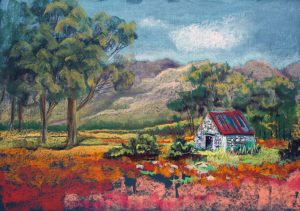
She yearned for artistic freedom painting landscapes and wildflowers, symbolic of exploring genuine female experiences, particularly her fondness for depicting dandelions, symbolising tenacity and strength. Wildflowers became a metaphor for her own existence, too: untamed and independent.

Despite her remarkable talent and being the first woman elected to Denmark’s Royal Danish Academy of Fine Arts, she remained on the outskirts of recognition within the Danish art establishment. Originally from Switzerland, Wegmann relocated to Copenhagen as a child, her artistic abilities nurtured by her father and later honed under the guidance of Frederik Christian Lund. In Munich, she found solace among progressive female artists, notably bonding with Jeanna Bauck, a significant collaborator.
Struggling against public indifference and financial constraints, Wegmann adjusted her ambitions, focusing on dignified portraits reminiscent of John Singer Sargeant’s style. Her skill in capturing the essence of her subjects garnered immense demand, with Wegmann refusing commissions regularly, even declining the esteemed J.B.S. Estrup.
Wegmann’s personal life, notably her relationship with writer Toni Möller, drew attention but didn’t overshadow her art. A vocal supporter of women’s rights, she utilised her public platform for advocacy. However, despite her prowess, Wegmann’s narrative didn’t comfortably align with Denmark’s artistic chronicles. Her status as a foreigner, education abroad, and being a woman seemed to hinder her acceptance. This led to a lack of acknowledgment in Danish art histories, with none of her paintings gracing local museums or galleries. According to some, xenophobia and misogyny might have played a role in her marginalisation. Bertha Wegmann, an artist ahead of her time, embraced independence and defied stereotypes, her legacy intertwined with her courage to challenge societal norms.
Keeping it in the family

Keeping it in the family

The hunting party comes back to the village nestled in the lowlands, tired dogs trailing behind them. A lone fox is impaled on one of the spears carried by the men. On the left, there’s activity as they prepare to roast a pig over an open fire. Charming elements, like people skating on frozen ponds, contribute to the widespread appeal of the scene. However, it’s not the individual details that give the painting its significance, but rather the overall impact. With both skill and consistency, Bruegel creates the impression of enduring cold in this foremost winter landscape in European art.

It all starts with Pieter Bruegel the Elder (circa 1525/30-1569), whose obscure origins are revealed in his surname, which literally means ‘small village’. An exceptional talent, he moved to Brussels as an adolescent to become the pupil of Pieter Coecke, the official artist to the Habsburg court. In pieces like The Peasant Wedding or Hunters in the Snow, both now housed in the Kunsthistorisches Museum in Vienna, Pieter Bruegel the Elder portrays everyday Flemish people. What’s fascinating is that he weaves in sophisticated and sometimes rebellious nods to poetry, philosophy, politics, and religion. What sets Bruegel apart is his groundbreaking use of oil paint to capture snowfall. Take Winter Landscape with Skaters and a Bird Trap where a trap in the foreground of a frozen scene, set before an open window, becomes a mysterious metaphor for the divine, with an unseen figure adding depth to the narrative.

Ever wonder how to spell the name of a famous artist correctly? Well, in the 16th and 17th centuries, there wasn’t just one right way! Pieter the Elder started with ‘Bruegel,’ but then Pieter the Younger added an ‘h’ around 1615, turning it into ‘Brueghel.’ That’s the name used by their family for generations! Later on, they switched the ‘u’ and the ‘e,’ and now we use that spelling for the less famous family members, starting from Jan the Younger onwards.

The intriguing question of how Bruegel’s sons carried on his artistic legacy is a captivating aspect of the Brueghel family saga. Pieter Bruegel the Elder, creating 45 paintings in his brief 45-year lifespan, left a remarkable artistic legacy. His sons, Pieter Brueghel the Younger (1564-1638), also known as Pieter Brueghel II, and Jan Brueghel the Elder (1568-1625), named so because his own son, Jan the Younger, inherited the name in the family tradition, both managed to achieve significant success as artists despite being under five years old when their father passed away.

Pieter Brueghel the Younger took charge of the family artistic enterprise, specializing in reproducing his father’s most renowned works. Notably, he crafted over 40 copies of “The Bird Trap.” Remarkably, Pieter Brueghel the Younger’s artistic journey extended into his seventies, during which he produced an impressive body of work, with almost 1,000 known paintings to his name. The tale of how the Brueghel sons carried forward their father’s artistic heritage is both enigmatic and inspiring.

Pieter Brueghel the Younger (1564-1638), The Battle between Carnival and Lent.

As Pieter Brueghel the Younger‘s art journey unfolded, he started creating his own unique artworks, diving deeper into countryside scenes and landscapes, often adding cheeky surprises. In a painting called “The Netherlandish Proverbs,” inspired by his dad’s work from 1559, he packed over 100 sayings into a lively scene.

Imagine this: people doing silly things like banging their heads on walls, tossing feathers in the breeze, and even the blind leading the blind.

The Bad Shepherd is an ambivalent version of the famous Bible story.

Did Jan Brueghel the Elder decide to follow the family tradition?

While Pieter Brueghel the Younger dutifully carried on the family legacy, Jan Brueghel the Elder took a more rebellious path. He ventured to Italy for nearly seven years, forging friendships with prominent artists, including his future collaborator Peter Paul Rubens. Returning to Antwerp in 1600, Jan Brueghel the Elder found himself at the forefront of artistic innovation. His repertoire included allegorical and biblical scenes, and he distinguished himself as one of the pioneers in still life painting, particularly of flowers. He became known for his ability to pack remarkable intricacy into his works.

One notable piece from 1610, An extensive wooded landscape with travellers on a road, a church in the distance, showcases his talent for painting expansive landscapes. This work stands out as one of the largest he ever created on copper, lending the paint a luminous quality. It was crafted during his tenure as the court painter to the governors of the Southern Netherlands.

Further down the family line, does the artistic talent spread out?

Certainly. Jan Breughel the Younger (1601-78), also known as Jan Breughel II, emulated his father’s artistic style. While some of his work is commendable, the presence of numerous assistants has blurred the lines, making it challenging to distinguish their contributions from his own. Subsequent generations, including Jan Pieter Breughel (around 1628 – before 1684), Jan Baptist Breughel (1647-1710), and Ambrosius Breughel (1617-1675), have garnered less recognition. Notable exceptions include the exceptional still-life painter Abraham Breughel (1631-1697), the son of Jan Breughel the Younger, and the highly skilled David Teniers the Younger (1610-1690), who became part of the artistic dynasty through marriage to one of Jan Brueghel the Elder’s daughters.

He had a beautiful way of painting

He had a beautiful way of painting

Back when they were all students at Collège Bourbon, Paul Cezanne, Louis Marguery, and Jean-Baptiste Baille became the best of friends, and they gave themselves the playful name “Les Inséparables” (The Inseparables). During their school days, Cezanne even stood up for Emile Zola when he faced bullies in the schoolyard. In a gesture of gratitude, Zola once presented Cezanne with a basket of apples. This simple act left a lasting impression on Cezanne, and from that moment onwards, apples became one of his cherished subjects in his art.

Cezanne’s pursuit of ‘earthly happiness,’ as mentioned in an interview during the late 1890s, centred around the creation of his unique belle formule, or ‘beautiful way of painting.’

Although he worked alongside the Impressionists, Cezanne was forging his distinct artistic path. During his early years, he employed a palette knife to lay down broad areas of colour in a flat and unmodulated manner. As his career progressed, he incorporated repeated small strokes of paint, either parallel or perpendicular, with varying shades to construct forms. This method of using small brush strokes resembled that of his fellow Impressionists, yet it distinguished itself by his deliberate and patient approach, often spending hours on a single line. In Cezanne’s painted realm, apples took on spherical shapes, houses manifested as cubes, and trees became combinations of cylinders. His compositions exuded a strong sense of structure, with a pronounced emphasis on geometric shapes. These shapes would at times exhibit a slight blurring, a testament to how he meticulously observed them from multiple perspectives. Cezanne’s analytical approach, where he connected everything he observed to its primary geometric form, and his manipulation of linear perspective and three-dimensional space, which involved flattening objects to concentrate on their surfaces and viewing them from diverse angles, laid the groundwork for the emergence of Cubism in the 20th century.

La mer à l’Estaque 

The Card Players (Les Joueurs de cartes)

Masters of Abstract Art – Kandinsky

Masters of Abstract Art – Kandinsky

In the late 19th and early 20th centuries, a significant transformation occurred in the world of painting, primarily in France. This shift was driven by the changes brought about by the Industrial Revolution and the liberalization of societal norms during the modern era. Various art movements emerged during this period, including Impressionism, Pointillism, Post-Impressionism, Fauvism, Cubism, Surrealism, and Abstract Art. During this time, artists evolved from mere observers to active participants in shaping modern society through their work. The creations of these visionary painters, who played a pivotal role in defining modern painting, are now highly sought after in the art market.

The advent of Abstract Art, characterized by non-representational forms, occurred just before World War I. Artists like Vasily Kandinsky, Robert Delaunay, Sonia Delaunay, and Kazimir Malevich pioneered this movement. The second wave of abstract art saw the emergence of artists such as Serge Poliakoff and Nicolas de Staël. 

Born in Moscow in 1866 and passing away in France in 1944, Kandinsky is regarded as one of the most exceptional artists of the 20th century, standing alongside Picasso and Matisse. His art journeyed through various avant-garde movements, influenced by the modernity and expressionism of his contemporaries and artistic companions.

Abstract art gained significant popularity after World War II, with Kandinsky continuing to be a prominent figure.

Kandinsky’s work often blurs the line between abstraction and representation. In his compositions, you may perceive shapes that resemble figures, a horse, or even a rider, although these forms are not clearly defined. This ambiguity is crucial in Kandinsky’s art, as it harks back to the rural paintings he encountered in the Church of Monö. One of the most significant influences on his work was the image of Saint George slaying the dragon, which resonates in his depictions. 

Wassily Kandinsky’s painted Composition IV in 1910. It depicts a woman standing in the middle of an abstract field of color, with her back turned to us and her arms spread out as if she were embracing all that surrounds her.

This painting was created in 1911 and is oil on canvas. The work currently belongs to the collection of the Museum of Modern Art in New York City, where it is considered one of Kandinsky’s most important works. The painting depicts the artist’s wife, Nina Kandinsky (1884–1944), who wears a black dress with violet flowers.

The composition is divided into two distinct parts: an upper section that features a flowery patterned background against which sits a figure wearing red clothes; and below this area, a turbulent yellow mass that takes up most of the canvas space and represents the artist himself.

Composition VII is the seventh in his series of abstract works with the same title, painted in 1923 and produced at a time when he turned away from pure abstraction to focus on figurative work.

Yellow Red Blue, also known as Composition VII, was painted in 1910. This piece of art is currently held by the Museum of Modern Art in New York City.

The painting consists of three colored shapes: yellow (top left), red (top right) and blue (bottom). The yellow shape appears to be slightly curved or rounded at its edges while the red and blue shapes appear as straight lines with sharp corners. The overall impression given by this work is one of lightness and movement due to how these simple geometric forms interact with one another on canvas.

Warhol’s Marilyn

Warhol’s Marilyn

On 9 May, Christie’s  20th/21st Century sale week in New York concluded with auctioneer Jussi Pylkkänen, Christie’s Global President, hammering down Andy Warhol’s Shot Sage Blue Marilyn for a record $195,040,000, making it the most expensive 20th-century artwork ever sold at auction.

Warhol’s Shot Sage Blue Marilyn became not only the most expensive 20th century artwork to sell at auction, but also the second most expensive work to sell at auction of all time — just behind Leonardo da Vinci’s Salvator Mundi, which sold at Christie’s in 2017.

Central to Warhol’s pantheon of pop icons, Shot Sage Blue Marilyn immortalises Monroe as the embodiment of celebrity, while cementing her image into the art historical canon. As an emblem of the American Pop Art movement, Marilyn represented the optimism and individuality and of the post-war Renaissance, fame, and celebrity. And yet, 60 years after Monroe’s untimely death, Warhol’s image has become so much more than the symbol of a single artistic movement. Marilyn is a masterpiece, not bound to time or place.

ANDY WARHOL (1928-1987)
Shot Sage Blue Marilyn
signed and dated ‘Andy Warhol / 64’ (on the overlap)
acrylic and silkscreen ink on linen
40 x 40 in. (101.6 x 101.6 cm.)
Painted in 1964.

error: Content is protected !!

Pin It on Pinterest