Piet Mondrian a pioneering modernist?

Piet Mondrian a pioneering modernist?

An abstract artist whose work was rooted in the language of landscape, Mondrian pared back his canvases to convey only essential forms — a process which, he said, was ‘not the creation of another reality, but the true vision of reality’

Mondrian’s first job after graduation was drawing bacteria at the Leiden University in the Netherlands

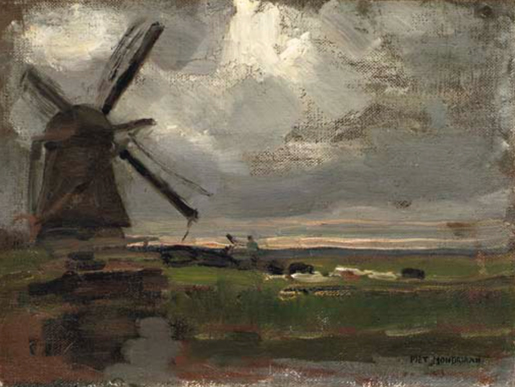
He was never a commercially successful artist. Mondrian’s early works were landscapes in the Hague School tradition: that is, broadly naturalistic scenes of the Dutch countryside, characterised by their subdued colour and muted light. He particularly liked to paint windmills on and near the Gein, a small waterway outside Amsterdam.

For much of his long career, he produced watercolours of flowers as a sideline to support himself.

He only ever had one dedicated collector: Salomon Slijper, a Dutch real estate developer. Slijper acquired work mostly made before the end of the First World War and, on his death in 1971, bequeathed it all to the Kunstmuseum Den Haag. Numbering almost 300 pieces, that museum’s Mondrian collection is today the largest in the world.

He was inspired by Fauvism, Pointillism, Luminism and Van Gogh

The end of the first decade of the 20th century was a noteworthy time for Mondrian. He was beginning to create art that might be called progressive.

Fauvism, Pointillism, Luminism and Vincent van Gogh all proved sources of inspiration — as can be seen in a painting such as 1908’s Windmill in Sunlight (part of Slijper’s bequest to the Kunstmuseum Den Haag).

In these years, Mondrian also paid regular visits to Domburg, a coastal town in the province of Zeeland. He produced numerous paintings of its seaside, sand dunes and piers. His palette had grown markedly lighter and more colourful than before, his brushwork sketchier and more spontaneous, and there was a definite move away from naturalism towards abstraction.

He settled in the French capital and became an adherent of Cubism, the style recently pioneered by Picasso and Georges Braque.

Mondrian’s Cubist work tended to be more abstract than that of the founding duo. His subject (often a tree) is commonly unrecognisable, reduced to interlocking black lines and planes of colour.

He created his most famous work while living in Paris

Refining his previous practice, he now hit upon a signature style: grid paintings consisting of horizontal and vertical black lines, which created rectangles and squares that he filled with passages of a primary colour, white or grey.

The orthogonal structure translates the effervescence of New York.

In New York, architectural gigantism, perpendicular urbanism and frantic traffic have a great impact on exiled European artists, just like Mondrian, who arrives there in 1940. This work is typical of Mondrian’s last research, after his neo-plastic period and black grids. His vertical and horizontal lines vibrate with colour, creating a luminous optical dynamic and an impression of movement. The dense criss-crossing over the entire surface magnifies the USA’s “new energy”, boosted by the discovery of the frantic boogie-woogie beat.

Here’s to glorious Venice

Here’s to glorious Venice

This Italian city’s distinct architecture with its water canals has captivated artist for centuries.

The intricate network of canals ensures that water is a constant presence throughout the city. Magnifying its atmosphere, light can be seen shining between buildings or at the end of a narrow street, bouncing off the water’s surface and causing reflections to dance along walls or on the undersides of bridges.

Artists like Canaletto, Turner, Moran, Sargent, Manet, Cross and Henri Le Sidaner responded in their own unique styles to this enchanting city.

Canaletto

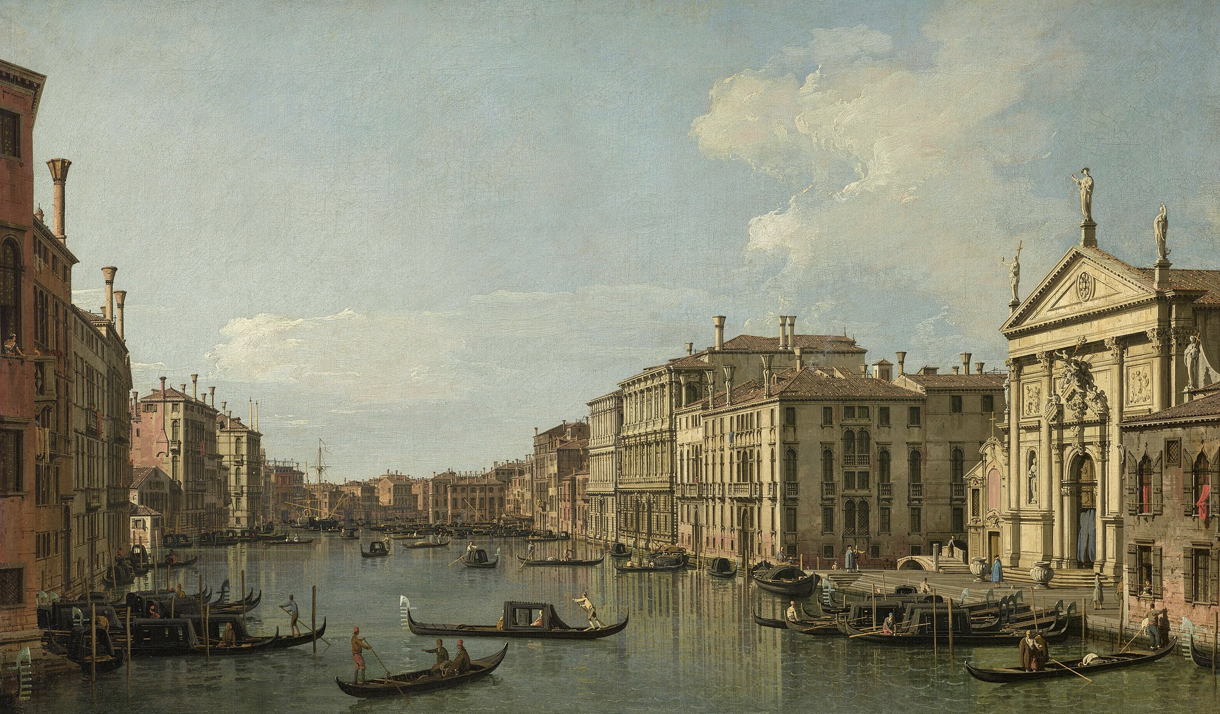
An important centre of maritime trade the Venetian-born painter Canaletto, popularised many of the key painterly vistas of the city in his exquisitely rendered vedute, recording the cityscape with a precision and clarity.

Turner

He produced a rich group of pencil studies, watercolours and oil painting portraying the unique atmosphere of the lagoon — the blend of mist and fog that crept in and blanketed the city blurring the lines of the buildings, monuments and gondolas as they moved through the water.

Moran

Influenced by Turner, Moran, selecting a similar view to the artist’s Bridge of Sighs, Ducal Palace and Custom House Venice: Canaletti Painting (circa 1833, Tate Britain, London), infusing the scene with his own subtle approach to colour and virtuosic handling of paint.  

Manet

The experience of gliding through the city’s intricate network of canals and waterways aboard a gondola, offers a fascinating perspective on Venice. ‘One way of looking at such facades is from a gondola,” wrote Joseph Brodsky, as quoted in Watermark (2013), ‘this way you can see what the water sees…’  It was this alternate perspective on Venice that sparked Edouard Manet’s imagination most, providing the artist with inspiration for a pair of canvases during his visit to Venice in 1874. This was the artist’s second and final sojourn in the city. Seen from the level of the water, Manet vividly captures the sensation of travelling through the city by boat in Le Grand Canal à Venise.  

Sargent

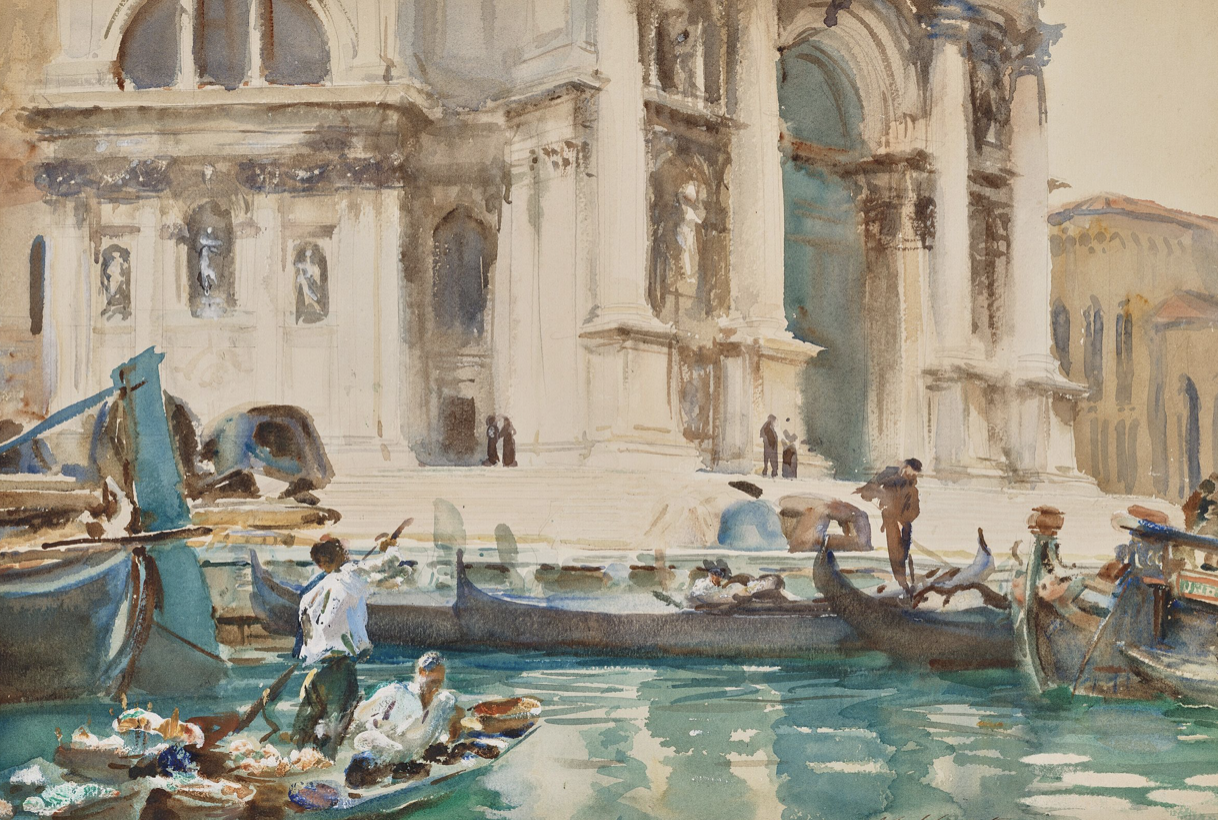
Similarly, John Singer Sargent often worked from the bow of a gondola, focusing his eye on the local play of life that filled the streets in quieter stretches of the city. In his exquisite watercolour, The Façade of La Salute from 1903, Sargent conveys a dynamic sense of the congestion that could strike within Venice’s waterways. 

Loose yourself in the mindscapes of MC Escher

Loose yourself in the mindscapes of MC Escher

Recognition came late in life for MC Escher. Only in the 1960s, did he become a countercultural icon, feted by the likes of Stanley Kubrick and Mick Jagger.

Escher had an intuitive understanding of mathematics, which proved crucial to his success as an artist. Beyond intuition, he also enjoyed reading about mathematical concepts, many of which — infinity, reflection, symmetry, tessellation, perspective — crop up in his work.

Another well-known work, Print Gallery (1956), above, depicts a man in an art gallery viewing a print of a port scene — and among the buildings in that port is the very gallery in which he stands. Escher was here making use of a mathematical process known as ‘recursion’.

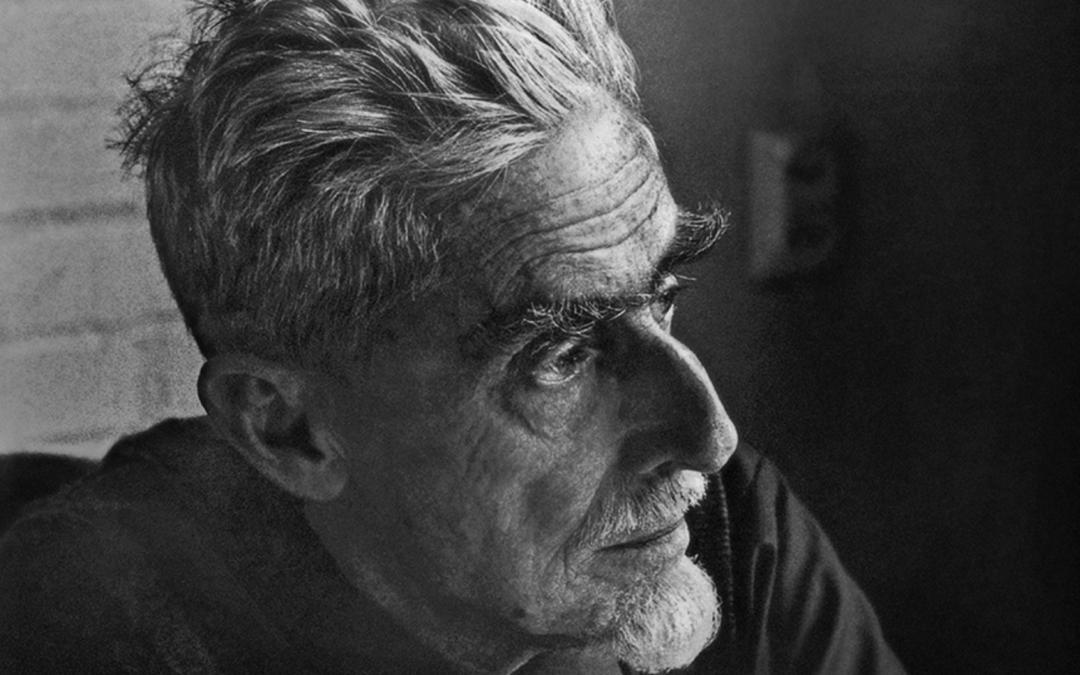
The Dutch artist M.C. Escher (1898-1972) once said of his image-making: ‘You have to retain a sense of wonder, that’s what it’s all about.’

A printmaker of distinction, Escher is renowned above all for his visual riddles and puzzles, which routinely result in heads being scratched. A floor might become a ceiling, an exterior might become an interior, or stairs might rise infinitely but lead nowhere.

This summer (2022), the largest ever Escher retrospective was held at the Museum of Fine Arts, Houston. Prices for his prints have shown a marked rise in recent years: in total, nine works by Escher have fetched more than $150,000 at auction, seven of those since 2019.

Let’s have some Umbrella fun

Let’s have some Umbrella fun

This is a fun project!

The illustration you need is available here for download. Of course, you can create your own!

Let’s get creative together. Let’s have some fun.

And, please, email me your results?  


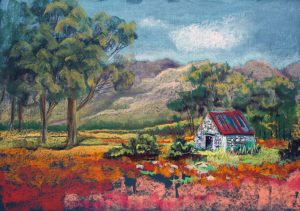
Landscaping in Soft Pastel

Landscaping in Soft Pastel

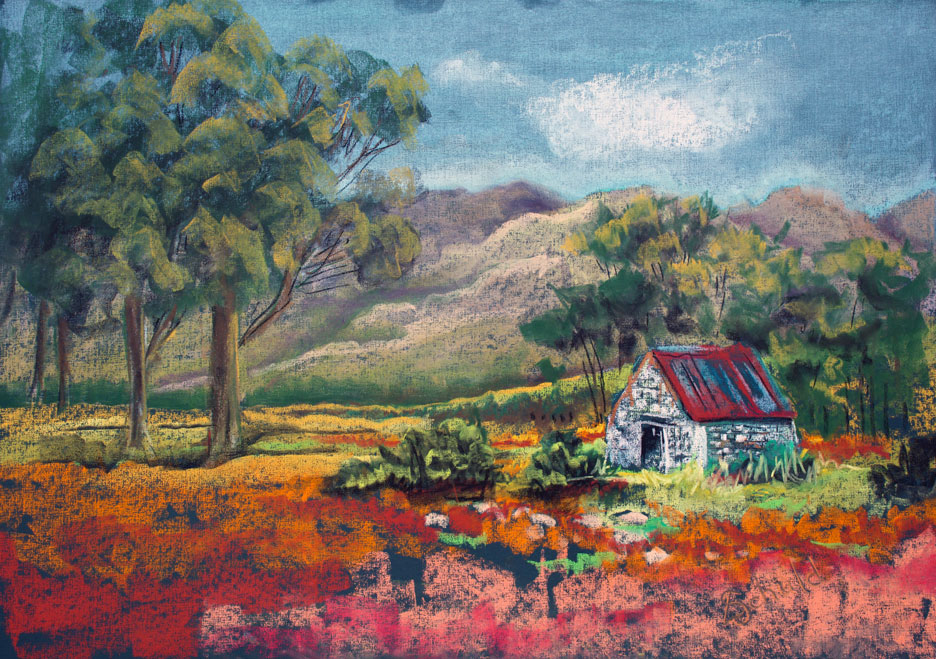
So, are you looking for inspiration? What I am about to show you in this video is a rather unorthodox way of getting the creative juices flowing. Go ahead, take a look and work with me. Please remember to subscribe to my channel. I will be uploading demonstrations every other week, typically on Mondays, that is, if nothing unforeseen happens! 

error: Content is protected !!

Pin It on Pinterest